




Why Railway Organizations Are Scaling RT3D Environments
What InnoTrans Revealed About the Growing Demand for RT3D in Rail.
This year’s InnoTrans in Berlin, the world’s leading rail transport trade fair, offered a valuable snapshot of the industry’s direction. As part of the Spanish railway delegation coordinated by MAFEX, Virtualware joined operators, infrastructure managers, rolling stock manufacturers, and technology providers from around the world to discuss the future of rail digitalization.
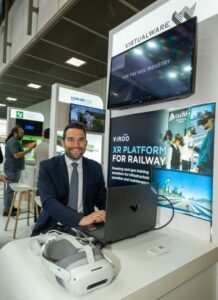
Many conversations pointed in the same direction: organizations are looking for scalable RT3D platforms that support training, engineering collaboration, digital twins, and operational readiness from a single digital environment.
As rail networks become more complex, these technologies are becoming essential tools for:
- Railway infrastructure training
- Railway maintenance training
- Driver familiarization
- Digital twin visualization
- Collaborative engineering
- Safety rehearsals
- Workforce onboarding
- Remote expert collaboration
- Operational simulations
- XR Rooms
As infrastructure becomes more digital and complex, workers need more practical experience while operational environments become harder to access. Safety regulations, operational constraints and certification requirements often limit opportunities for hands-on learning.
In many cases, technicians need familiarity with an environment before they can obtain authorization to access it. XR and RT3D environments provide a practical way to overcome these constraints, allowing personnel to train inside realistic digital replicas of railway infrastructure.
According to the European Union Agency for Railways (ERA), digitalization is reshaping skills requirements across railway operations, maintenance and infrastructure management.¹
Instead of waiting for access to a depot, station, maintenance area, or operational track section, personnel can begin familiarizing themselves with assets, procedures, and workflows from day one.
The International Union of Railways (UIC) has consistently promoted simulation-based learning as an effective way to provide practical experience while minimizing disruptions to railway operations.²
A practical example: ADIF’s RITS platform
A good example of how XR is being applied in railway infrastructure training is the Railway Infrastructure Training Simulator (RITS), developed jointly by ADIF and Virtualware and powered by the VIROO enterprise XR platform. ADIF, one of Europe’s largest railway infrastructure managers, needed a scalable way to train railway maintenance personnel while reducing dependency on physical access to operational infrastructure.
The result was RITS (Railway Infrastructure Training Simulator) a railway training ecosystem that covers the complete learning lifecycle:
- Content creation
- Exercise design
- Session management
- Assessment and evaluation
- Multi-user training
- Desktop deployment
- VR deployment
- Immersive room deployment
RITS enables workers to learn and practice procedures inside realistic railway environments before accessing operational infrastructure, reducing risks and accelerating readiness.
Research by PwC found that VR learners can train faster, retain confidence more effectively and achieve stronger engagement than traditional classroom-only approaches.³ Organizations that succeed with XR typically treat immersive environments as strategic digital infrastructure rather than isolated applications.
Addressing these requirements requires more than standalone applications. Organizations need a platform capable of deploying, managing and scaling immersive solutions across locations and teams, providing:
- Centralized content management
- Multi-user collaboration
- Identity and access control
- Cybersecurity and governance
- Analytics and reporting
- Content version control
- Deployment across desktops, VR headsets and immersive rooms
- Public cloud, private cloud and on-premises deployment options
The Future of Railway Training and Operations
As railway organizations expand their use of immersive technologies, the focus is shifting toward scalable RT3D environments that can support training, engineering, collaboration and operational readiness from a common platform. With VIROO, railway companies can transform digital assets into reusable environments that improve learning, coordination and decision-making across the organization.
References
¹ European Union Agency for Railways (ERA), reports on digitalisation, skills and workforce development.
² International Union of Railways (UIC), simulation and railway training initiatives.
³ PwC, The Effectiveness of Virtual Reality Soft Skills Training (2020).