


From one-off experience to shared capacity: how to integrate XR systemically into VET
A new model of digitalization in vocational training
The public organizations that manage Vocational Education and Training (VET) around Spain are no longer discussing whether it should be digitized, but how to do so with a real impact on employability, teaching innovation, and its connection with industry. The Spanish Ministry of Education has defined digitalization as a transversal “base element” of vocational training teaching.
It has created over 1200 Applied Technology Classrooms (ATECAs) and has established a state network of Centers of Excellence that began initially with 66 centers and currently is made up of 75 centers distributed throughout all the autonomous communities in Spain. This evolution is not cosmetic: it expresses a change of model towards connected learning spaces, applied technology and transfer between centers and industries.
In this context, Extended Reality (XR) should not be incorporated into VET as simply a set of flashy pilots, nor as a group of isolated experiences that depend on a single provider, or dependent on a short-term subsidy, nor focused on a single industry.
If VET really wants to take advantage of the potential of immersive simulation, 3D review, secure training, and remote collaboration, XR needs to be considered an educational infrastructure: a stable digital layer that allows content to be created, managed, deployed, updated, and shared at the local level of a school, the regional network, and the larger state network.
It is to build operational capacity and governance for the content that has been developed and deployed.
Content Consumer vs Content Generator? The key to the hybrid model for VET centers
The first strategic decision for any VET center or VET network is to decide whether it wants to limit itself to consuming content or wants to be in a position to generate it. In Vocational Training, this distinction is crucial. It’s typical in industry for processes to change, machinery to evolve, regulations to be updated, security protocols to be reviewed, and each VET center will have its own needs linked to its specialization(s) and business environment.
However, the most efficient solution is not to choose one model or another, but rather to adopt a hybrid model consisting of:
- Libraries of standardized content to cover transversal competencies, common regulations, or shared occupational risks.
- Authoring and agile adaptation capabilities to replicate specific facilities, reflect local procedures, or respond with agility to emerging demands of target industries
That’s why choosing the right platform matters even more than the content itself. What schools need is not just a headset and a flashy experience, but a solution that allows teachers and technical teams to create or adapt their own content, publish it in a controlled way, manage it by user profiles, and deploy it on different devices without needing to totally redo the development work.
That’s the difference between a simple XR system meant to run a superficial application, and an XR platform fully integrated into the logic of a VET system.
Recent research on immersive learning reinforces this approach: systematic reviews show that immersive virtual reality adds value, especially when it favors active participation, object manipulation, procedural practice, and task solving, but not when it is limited to passive observation.
Multi-user immersive rooms: team pedagogy
The second pillar of implementing XR in VET, and one that is often underestimated, is multi-user immersive rooms. If VET aspires to better reproduce the reality of work, it cannot think of XR only as an individual experience with a single headset. A large part of contemporary production environments – industry, construction, logistics, health, energy, automotive or maintenance – requires coordination, communication, supervision and shared decision-making among a team of persons.
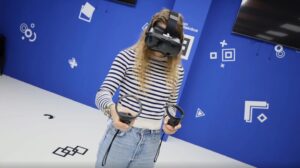
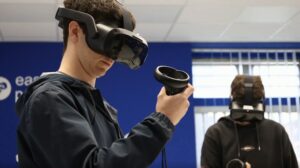
Virtual reality rooms allow just that: to work on a real scale, with several participants at the same time, in the same virtual environment, and to do so in a hybrid way with remote users in different locations or even with participants in desktop mode. Compared to the model of “one student, one headset, one activity”, the immersive room introduces a team pedagogical model that is much more aligned with real-world professional practice and active methodologies based on challenges, collective review, and process simulation.
The advantage of these rooms is not only pedagogical; it is also organizational.
They allow you to turn a classroom, a laboratory, or a multipurpose space into an environment where critical procedures are tested, BIM or CAD models are reviewed, risks are analyzed, assembly sequences are practiced, or situations that are difficult to reproduce in real conditions are trained. They do so with a particularly valuable feature for VET: they permit continuous learning and practice without compromising safety, consumables or availability of real equipment.
In sectors where every mistake can be costly – or directly dangerous – the ability to train, repeat, make mistakes and try again in an immersive environment offers a significant competitive advantage. Studies on XR in the educational field highlight its usefulness for procedural knowledge, practical skills, and technical training in complex environments.
Networking and teachers as prosumers
The third systemic element is the networking of the centers. The current modernization of Spanish vocational training is not being proposed on a center-by-center basis, but as a building process of collaboration between centers. The Centers of Excellence are conceived as nodes of innovation, applied research, teacher training, and the development of projects with companies; and the ATECAs are designed to recreate digital work environments and reinforce methodologies connected to the professional world.
From this logic, XR should not be implemented as technological ‘islands’, but as a shared digital infrastructure. This is where teachers cease to be simply software ‘consumers’ and instead become ‘prosumers’ (a producer and a consumer) within communities of practice: one school develops a training module on electrical maintenance; another adapts it to specific machinery; a third adds an assessment; and a fourth incorporates a layer of occupational safety.
If the infrastructure allows these resources to be shared, versioned, and deployed in common, the network gains speed, coherence, and sustainability, multiplying the return on investment. On the other hand, if each school acquires closed content that it cannot modify or redistribute, the system is fragmented, and investment is exhausted after a short period. This need for a common repository and governance is implicit both in the VET network strategy and in the growing ministerial importance of digital twins and associated management tools.
Mature hardware and open standards
Naturally, this vision only works if it is accompanied by the integration of the correct hardware. This is where it’s critical to overcome another common simplification: not just any headset, not just any PC, and not just any IT network can be used for a serious implementation of XR technology in vocational education and training.
When working with collaborative simulation, complex virtual scenes or multi-user deployments, you need devices that guarantee:
- Open standards support (OpenXR): A critical factor in education to avoid rapid deprecation and lock-in with a single hardware vendor.
- Operational Capability: Execution stability, professional room management, session synchronization, and robust connectivity.
- Ease of administration: Robustness, hygiene of hardware, autonomy, space safety and traceability of the devices to maintain continuous operation with large groups
Towards the technological sovereignty of the system
In the Spanish market there are already concrete examples that point in this direction. One of the most relevant is our platform, VIROO, although the important lesson is not the brand, but the type of proposal.
Our public documentation shows a platform aimed at the management, governance and deployment of real-time 3D applications (RT3D) developed with Unity or Unreal, with multi-user network support, XR deployments, and operation options in both public and private clouds, as well as on-premises. In addition, our architecture includes specific players for desktop environments, immersive rooms, and CAVE-type systems, which fits exactly with the idea of a scalable infrastructure and not a simple isolated application.
Its interest for Spanish VET organizations lies precisely in the fact that it fully represents the leap from the simple purchase of XR experiences to the more valuable construction of internal capacity of the organizations. According to our own data and XR sector media sources, we have already deployed the platform in more than 80 VET centers in Spain. There is an important presence in the Basque Country, where we have 25 VET centers equipped with licenses and multi-user immersive rooms.
Specific centers, such as CIFP Politecnico EASO or Miguel Altuna, are using our immersive environments to train technical procedures and review models collaboratively. We have also publicly announced a six-year agreement linked to the deployment in VET centers of excellence; in parallel, the Spanish Ministry of Education has formalized large-scale contracts in 2026 for software and licenses for simulators and digital twins, an unequivocal sign that the institutional integration of these technologies is entering the structural phase.
The underlying question, therefore, is not whether XR “has potential” in Vocational Training. That question has already been answered. The question is how to prevent this potential from being diluted in disconnected solutions. Spain has made a notable effort to modernize vocational training with ATECA, Centers of Excellence and a transversal digitalization agenda. The next logical step is to consolidate a shared immersive infrastructure that guarantees the technological and training sovereignty of the centers.
The real transformation will not be the day when there are more XR headsets in the classrooms, but rather the day when VET organizations have a network capable of turning XR into a structural capacity of the system: connected to industry, valuable for both teachers and students, shared between schools and ready to evolve at the pace of the productive world.
In this scenario, extended reality ceases to be a peripheral innovation and becomes what it really needs to be for VET: a sovereign infrastructure to learn better, collaborate more, and transfer knowledge without friction.
Want to transform XR from a classroom experiment into a strategic capability?